
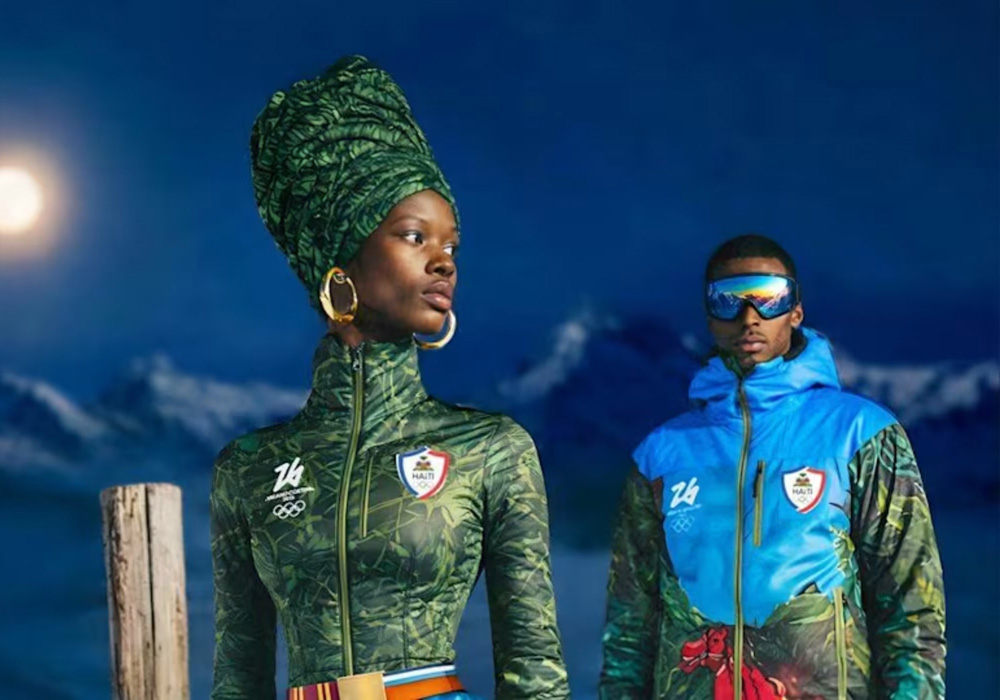
Two Haitian skiers arrive at the Milano Cortina 2026 Winter Olympics carrying stories shaped by migration, discipline, and belief. Their presence, paired with Stella Jean’s powerful uniforms, reframes who belongs in winter sports and why visibility matters.
When Haiti enters the stadium at the Milano Cortina 2026 Winter Olympics, it does so with just two athletes, yet with a presence that far exceeds numbers. Richardson Viano and Stevenson Savart carry with them stories shaped by migration, adoption, discipline, and an unshakeable connection to a country not traditionally associated with snow. Their participation reframes who winter sports are for, and who gets to be seen on the world’s coldest stage.
Representation matters here. Haiti’s appearance in alpine and Nordic skiing expands the imagination of what is possible, especially for young athletes from places rarely reflected in winter sport narratives. Viano and Savart are not symbolic add-ons to the Games. They are competitors who trained, qualified, and earned their place. Their presence asserts that access to winter sports is not limited by geography, climate, or expectation.
Richardson Viano and the first tracks
Born in Croix-des-Missions, Haiti, Richardson Viano spent his early years in an orphanage before being adopted at age 3 by an Italian couple living in the French Alps. The move from the Caribbean to the mountains of Briançon was disorienting, but it also introduced him to what he famously called “magic powder.” Snow became both a curiosity and a calling.
With a ski instructor as an adoptive father, Viano grew up immersed in alpine culture. Years later, a call from the Haitian Ski Federation invited him to reconnect with his country of birth through sport. He accepted, switching nationality in 2019 and becoming Haiti’s first-ever Winter Olympian at the Beijing 2022 Games. Now returning for Milano Cortina 2026 in alpine skiing, Viano represents continuity and growth, proof that Haiti’s winter sport story is no longer an anomaly, but an unfolding chapter.
His journey is defined by discipline and quiet determination rather than spectacle. Racing down icy slopes in Europe, Viano competes against athletes from nations with deep winter-sports infrastructure, yet he does so wearing Haiti on his back, challenging assumptions with every run.
Stevenson Savart and endurance over distance
Stevenson Savart’s path to the Olympics follows a different rhythm. Adopted by a French family at age 3, he grew up in La Bresse in the Vosges, where cross-country skiing is a way of life. Unlike alpine skiing’s explosive bursts, Savart’s discipline demands patience, stamina, and an ability to endure long distances in punishing conditions.
Savart originally competed for France, making his international debut as a junior, before choosing to represent Haiti in the 2022–23 season. The decision was practical and deeply personal. Competing for Haiti opened a door that had closed elsewhere, but it also allowed him to race with purpose beyond placement. Alongside training and competition, Savart trained as a carpenter, grounding his athletic life in craft and precision.
At Milano Cortina, he becomes Haiti’s first Olympic cross-country skier. In a sport dominated by northern nations, Savart’s presence underscores that endurance is not owned by geography. It is built, kilometre by kilometre.
Uniforms that carry history onto the snow
Before either athlete clips into their skis, Haiti has already made headlines for its uniforms, designed by Italian-Haitian fashion designer Stella Jean. Known for merging Italian tailoring with African and Caribbean visual languages, Jean approaches fashion as a form of cultural storytelling. Her work has appeared on international runways and, most recently, at the Paris 2024 Summer Olympics, where Haiti’s uniforms were added to the Olympic Museum’s permanent collection.
For Milano Cortina, Jean drew inspiration from a painting by Haitian artist Édouard Duval-Carrié depicting Toussaint Louverture on a red horse, a reference to the leader of the Haitian Revolution and the birth of the world’s first Black republic in 1804. The original design prominently featured Louverture on the uniform, a clear assertion of historical pride.
The International Olympic Committee intervened, ruling that the image violated rules prohibiting political symbolism on Olympic uniforms. Faced with a tight deadline and no budget, Jean made a radical and poetic decision. Working with Italian artisans, she painted over Louverture’s figure, leaving behind the riderless red horse charging across a sky-blue, tropical background.
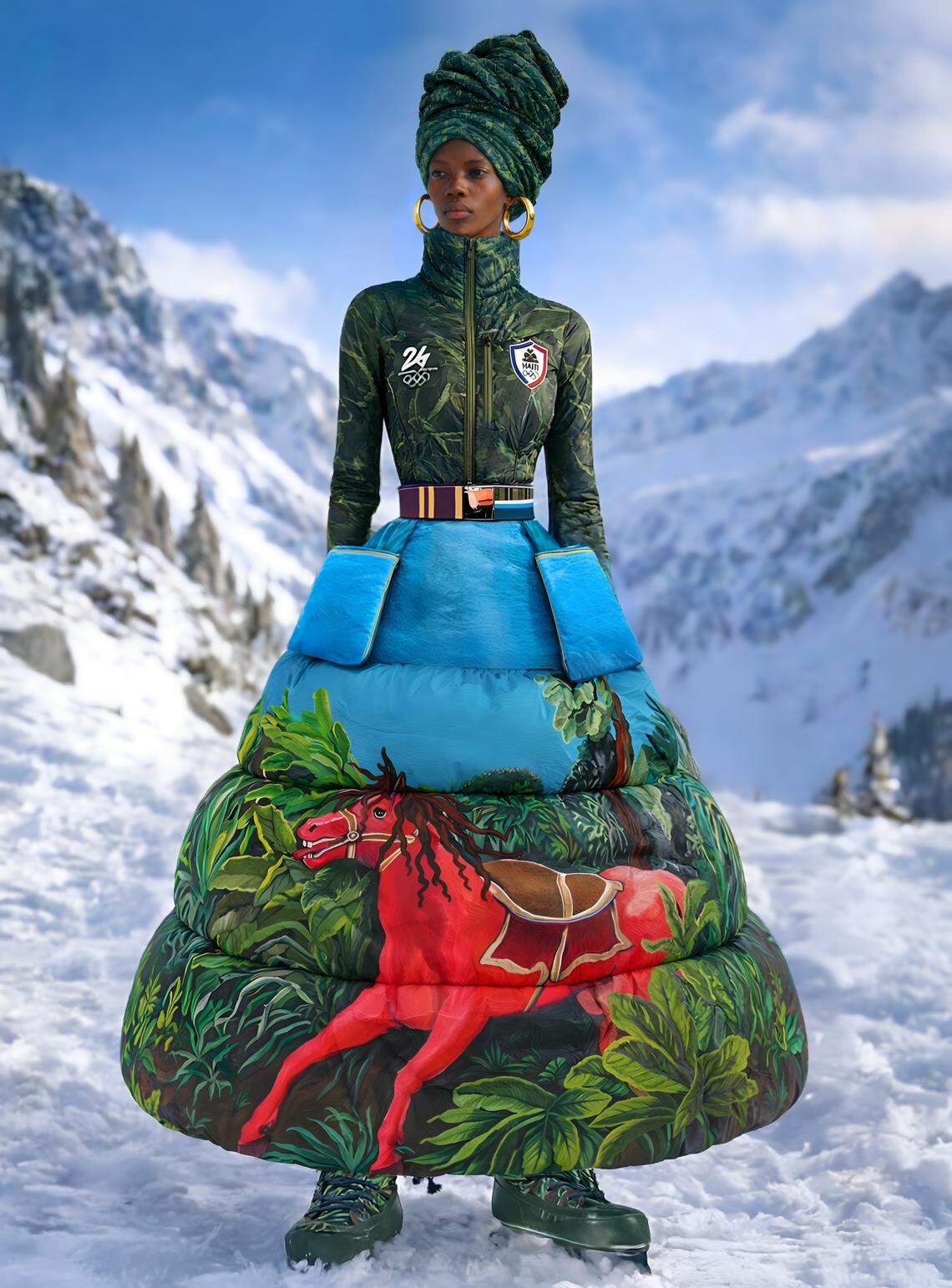
The result is striking. The absence is unmistakable. The missing rider invites questions rather than silence. Who was he? Why is he gone? In removing the figure, the design amplifies his presence. Toussaint Louverture becomes more visible through erasure, a reminder that history often speaks loudest through what is omitted.
Jean extended this layered storytelling across the delegation’s attire. Female team members wear puffer skirts and the traditional Haitian tignon headwrap, a reference to a garment once imposed on Black women under colonial rule, later reclaimed as a symbol of dignity and identity. Every element carries intention. Every stitch holds memory.
Visibility that opens doors
Haiti’s participation in the Milano Cortina 2026 Winter Olympics is not framed here as defiance against hardship, nor as a novelty. It stands as an affirmation of belonging. Viano and Savart show that winter sports are open to those willing to commit, regardless of where they were born or how unlikely the path may seem.
Their uniforms echo the same message. Culture travels. History adapts. Presence matters. For Haitians at home and across the diaspora, these moments resonate beyond results tables. For global audiences, they quietly expand the boundaries of who winter sport is for.
On snow-covered slopes far from the Caribbean, Haiti arrives fully formed, carrying its stories, its athletes, and its art into a space that is broader because they are there.