
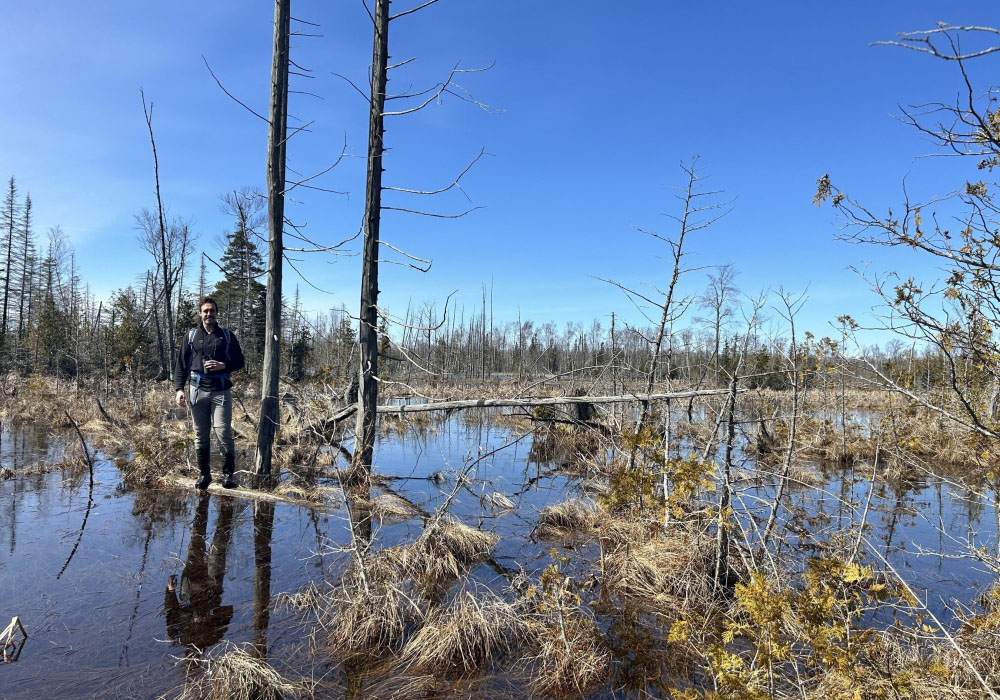
Ontario Nature has permanently secured 26.7 hectares of rare coastal dune habitat along Lake Huron's eastern shore, officially expanding the Sauble Dunes Nature Reserve to nearly 78 hectares. The acquisition of Sauble Dunes North protects fragile dunes, wetlands, and forested swales that shelter 24 species at risk — land that was previously slated for residential development. It's a major conservation win for the Saugeen (Bruce) Peninsula.
There's a stretch of land along Lake Huron's eastern shore that most people have never heard of, yet it has stood for thousands of years. Forested sand dunes shaped by post-glacial processes, wetland marshes threaded with rare plants, and swales sheltering species on the brink — this is the Sauble Dunes landscape, and as of March 2026, a critical piece of it is protected forever.
Ontario Nature has officially acquired Sauble Dunes North, a 26.7-hectare (66-acre) property on the Saugeen (Bruce) Peninsula. The acquisition expands the existing Sauble Dunes Nature Reserve to 77.78 hectares (192 acres), completing a conservation corridor linking some of the region's most ecologically significant habitats. The announcement marks the culmination of years of effort by Ontario Nature, its members and donors, government partners, and Indigenous communities who have long known the value of this land.
What makes this especially significant is what Sauble Dunes North faced. Prior to the acquisition, the property was privately owned by a developer and zoned for rural development. Residential construction and road-building were genuine possibilities. The window to act was narrowing fast.
What Sauble Dunes North actually is
The Sauble Dunes area falls entirely within the Sauble Falls North Life Science Area of Natural and Scientific Interest (ANSI), which encompasses 764 hectares between Sauble Falls and Oliphant in Amabel Township. It's considered one of the best remaining examples of beach ridges, sand plains, sand dunes, and swales in the region.
The newly protected parcel specifically encompasses fragile coastal dunes, wetland marshes, forested swales, and treed swamps. Coastal dune ecosystems are among the rarest habitat types in Canada. Forested sand dunes, like those at Sauble Dunes, are even more uncommonly shaped over thousands of years by wind, water, and the retreat of post-glacial Lake Nipissing.
The dunes in the Sauble Beach area are composed of fine sand, making them particularly vulnerable to erosion from storm waves, wind, and human activity. The post-glacial lake deposits that formed the dunes represent thousands of years of geological processes — processes that can be disrupted or destroyed remarkably quickly.
Species that depend on this land
The ecological case for protection is compelling. Sauble Dunes North provides habitat for 24 species at risk and more than 40 rare species. Some of the notable residents include:
- Eastern whip-poor-will (special concern)
- Canada warbler (special concern)
- Eastern ribbonsnake (special concern)
- Monarch butterfly (endangered)
- Wood thrush (threatened)
- Black ash (threatened)
The broader Sauble Dunes reserve and its connected wetlands also provide habitat for the provincially threatened Massasauga rattlesnake, several species of frog and salamander, red-shouldered and Cooper's hawks, and numerous songbirds, including the yellow-rumped warbler, purple finch, and northern waterthrush. The area serves as a locally significant feeding and migratory habitat for water and shorebirds as well.
This isn't a landscape with one or two headline species. It functions as a full ecosystem — a mosaic of microenvironments that support biodiversity at every level.
How the corridor comes together
The newly protected parcel sits between the Sauble River and Lake Huron, and its location was strategically important. By connecting to Chief's Point Wetland, Sauble Falls Provincial Park, county forests, and adjacent protected properties, Sauble Dunes North closes gaps in an ecological corridor that had long been incomplete.
Corridors matter enormously for wildlife. Fragmented habitats isolate populations, restrict movement, and reduce genetic diversity. A continuous stretch of protected land allows species to migrate, breed, and respond to environmental changes without running into development at every turn.
As Andrés Jiménez Monge, Executive Director of Ontario Nature, put it: "By entrusting Ontario Nature with this place, they have given us both the privilege and the responsibility to keep widening the corridors of safety that biodiversity needs to endure and recover across this province."
Who made it happen
This acquisition didn't come from a single source of funding or goodwill. It was a coordinated effort across government, civil society, and community donors. Key contributors included:
- The Government of Canada's Natural Heritage Conservation Program, through the Land Trust Conservation Fund, is administered by Wildlife Habitat Canada
- The Ontario Ministry of Environment, Conservation, and Parks, through its Greenlands Conservation Partnership program, administered by the Ontario Land Trust Alliance
- Echo Foundation and Waterloo Region Nature, which provided critical funding
- More than 750 Ontario Nature members and conservation partners
The Greenlands Conservation Partnership program, worth noting, is the single largest provincial fund for securing private land in Ontario. For every dollar of provincial funding invested, grant recipients must match it with at least two dollars from other sources. Since 2020, the program has helped protect over 430,000 acres of private land across the province.
Federal Environment Minister Julie Dabrusin also weighed in: "Sauble Dunes North plays a vital role in supporting species at risk and maintaining the ecological integrity of the Lake Huron shoreline."
What happens next
Ownership is secured, but the work doesn't stop there. Ontario Nature will integrate Sauble Dunes North into its existing nature reserve management plan, with a focus on long-term protection, habitat restoration, invasive species management, and species-at-risk monitoring.
It's also worth noting that this is a protected area, not a public trail destination. The dune ecosystems are extremely vulnerable to erosion from foot traffic and vehicle use, so the reserve does not have a marked trail system and is not currently open to general visitors. Those interested in research or education opportunities are encouraged to contact Ontario Nature directly.
The Saugeen Ojibway Nation's Chief's Point reserve lands sit directly adjacent to the property. Ontario Nature acknowledges the 46 treaties and agreements that cover Ontario and recognizes the inherent rights and responsibilities of Indigenous Nations, who have stewarded this land since long before it required protecting.
A rare thing, held a little longer
Conservation victories can feel abstract until you know what was almost lost. Sauble Dunes North was one permit cycle away from becoming a subdivision. The forested sand dunes, the ribbonsnakes threading through wetland grass, the whip-poor-wills calling at dusk — none of that is guaranteed to persist without deliberate, funded, legally binding action. That action happened here.
For outdoor explorers and nature-minded travellers, this kind of news should feel personal. The landscapes that inspire us to get outside — the ones that feel ancient and unhurried — exist because somebody fought to keep them intact. The Sauble Dunes acquisition is proof that community-driven conservation, when backed by political will and sustained funding, still works.
The Bruce Peninsula remains one of Ontario's most rewarding regions for those seeking genuine wildness. With 192 acres now permanently woven into its ecological fabric, it just got a little more resilient. That's something worth paying attention to.